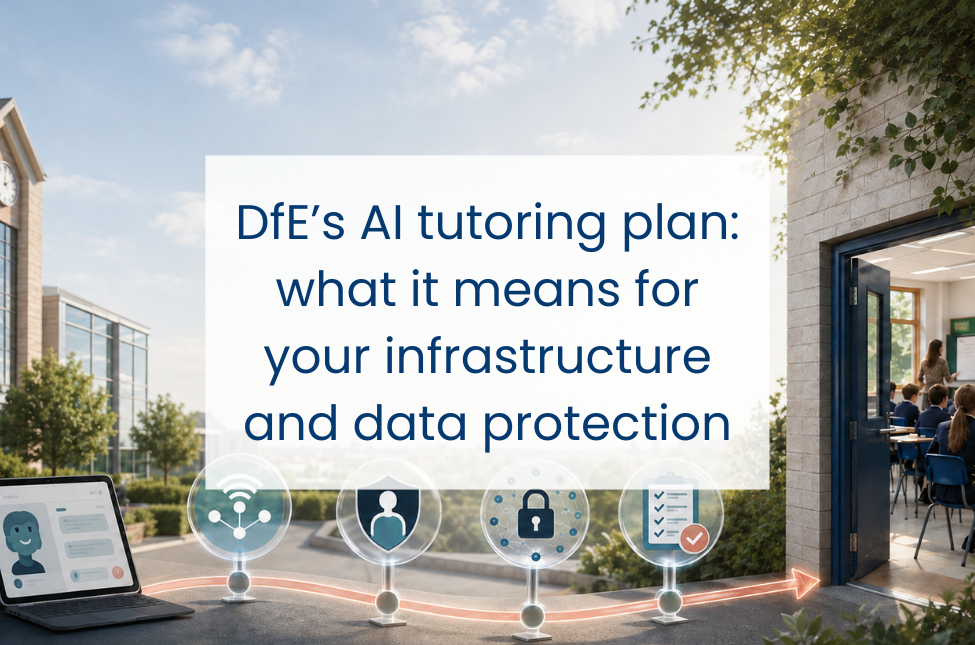
As schools begin the new academic year, AI tutoring is moving quickly from a future possibility to something schools may soon need to support in practice.
At Everything ICT, we help schools and trusts access suppliers who can support the full range of requirements around AI adoption, from networks and devices to filtering, safeguarding and data protection. The technology may be new, but the questions are familiar. Will it work reliably? Is pupil data protected? And has the school followed a compliant route to market?
Those questions have become more pressing following the Department for Education’s collaboration with i.AI to develop AI tutoring tools for up to 450,000 disadvantaged pupils.
The DfE and i.AI are working with eight “Pioneer” EdTech and AI companies to co-design tools with teachers. The initial focus is pupils in Years 9 to 11 studying English, maths, science and modern foreign languages.
The programme is now moving into its school-testing phase, with suppliers expected to work with schools during the new academic year. The tools are ultimately intended to reach more schools by the end of 2027.
As this work moves into school testing, there is a practical question for school leaders: is your school or trust ready, both operationally and legally?
What the initiative involves
The programme sits within the government’s wider “Every Child Achieving and Thriving” plans and a £23 million expansion of the DfE’s AI in Education EdTech Testbeds programme.
Its ambition is to support up to 450,000 disadvantaged pupils each year, particularly those receiving free school meals who may not have access to privately funded one-to-one tutoring.
Well-designed, teacher-supervised tutoring can provide valuable personalised support and help close gaps in attainment.
Infrastructure considerations
AI tutoring tools may place different demands on school technology than more conventional online learning platforms, particularly when they are used across multiple classes at the same time.
The practical impact will depend on how the platform fits within the wider technical environment, including connectivity, devices, filtering and access controls.
Bandwidth and wireless coverage
Broadband capacity and wireless performance will be important where the platform is likely to be used at scale.
The main consideration is whether the existing network can support concurrent use without affecting other essential systems. Performance may also vary across the estate, depending on classroom coverage, access-point capacity and the number of devices connected at any one time.
Device compatibility
Although many AI tutoring tools are browser-based, performance may still vary across the device estate.
Older Chromebooks and laptops may be more susceptible to slow response times, freezing or repeated logouts, particularly where they are approaching the end of their supported life. Compatibility, browser support and security updates are therefore likely to form part of any technical review.
Filtering, safeguarding and MDM
Filtering and access controls will also need to be considered as part of implementation.
Existing restrictions on AI or chatbot services can affect how an approved platform functions, while more open access can create additional safeguarding or content-management questions.
It will also be important to understand how pupil interactions are moderated, how concerning content is handled and whether staff can review relevant conversations where necessary.
Mobile device management may provide further options for controlling access by year group, class, device or user role. Reviewing these arrangements in advance can help ensure the platform is introduced in a way that aligns with the school or trust’s existing systems and policies.
Data protection is an obligation
AI tutoring tools can process a detailed range of information about pupils, including their answers, mistakes, areas of weakness, progress and conversations with the platform.
They may also collect technical information such as device details, IP addresses, login records and usage logs.
Together, this can create a detailed picture of how an individual child learns. Introducing an AI tutoring platform should therefore be treated as a significant data protection decision, not simply a software purchase.
Where a tool processes children’s personal data at scale or uses innovative technology that could create a high risk, a Data Protection Impact Assessment should be completed before it goes live.
A DPIA should establish what data is collected, why it is needed, where it is stored, who can access it and how long it is retained. It should be completed early enough to influence the procurement decision, rather than after a contract has been signed.
Government backing does not remove local responsibility
DfE-backed platforms will still need to be checked against each school or trust’s own environment and infrastructure. Government backing provides valuable assurance, while local checks help confirm that the tool is suitable for the setting in which it will be used.
That includes identifying the lawful basis for processing, reviewing privacy information, checking contractual terms and understanding whether the supplier uses pupil data for any purposes beyond delivering the service.
The ICO’s Children’s Code is relevant to services likely to be accessed by under-18s. Schools should expect privacy-protective default settings, proportionate data collection and clear evidence that the best interests of children have been considered.
Don’t forget a government pilot does not remove your school’s own responsibilities.
Questions to put to suppliers
Before agreeing to a trial or signing a contract, schools should ask:
What data is collected?
This should cover account details, pupil conversations, performance information and technical data.
Where is the data stored?
Schools should know whether data remains in the UK or EEA and what safeguards apply if it is transferred elsewhere.
Is pupil data used to train the AI?
Suppliers should explain whether prompts, responses or usage data are used to train or improve the model, and whether information is shared with a third-party AI provider.
How long is data retained?
There should be a clear retention schedule for accounts, conversations, backups and system logs.
Who can access pupil conversations?
Schools should know whether conversations can be viewed by teachers, administrators, supplier staff or external providers.
What happens when a pupil leaves or the contract ends?
The supplier should explain how data is deleted, not simply how an account is disabled.
Is there a Data Processing Agreement?
The agreement should cover security, subprocessors, breach reporting, deletion and support for data subject rights.
A supplier that cannot answer these questions clearly should be treated with caution.
The procurement route matters
How schools buy matters as much as what they buy.
Where a framework route is appropriate, schools and trusts will need to confirm that its scope covers the intended service and follows the relevant buying process.
For lower-value procurements, schools and trusts will need to follow their own standing orders, financial regulations and local procurement policies, alongside the relevant requirements of the Procurement Act 2023.
Evaluation should look beyond price and product demonstrations. It should consider educational suitability, accessibility, technical compatibility, safeguarding, data protection, cyber security, supplier support, social value and whole-life cost.
“Free” trials also require proper due diligence. Even without an initial fee, a pilot can involve pupil data, staff time and longer-term reliance on a supplier.
How Everything ICT can help
Everything ICT gives schools and trusts access to suppliers who can support the technical, data protection and implementation requirements associated with AI tutoring tools.
We can provide access to suppliers through a procurement route suited to the value and nature of the requirement.
Where a framework is required, schools and trusts can use Everything ICT to access suitable suppliers through a compliant framework route.
For lower-value procurements, where a framework may not be necessary, Everything ICT can also provide access to suppliers through a proportionate process that aligns with your local policies and the relevant requirements of the Procurement Act 2023.
This can include access to suppliers able to support:
- network, wireless and device readiness;
- filtering, MDM and access controls;
- DPIAs and supplier due diligence;
- data-processing and contractual requirements; and
- implementation and ongoing technical support.
The aim is to make it easier for schools and trusts to reach suitable suppliers through a procurement route that is proportionate, compliant and appropriate to the requirement.
What to check now
With testing under way and wider school involvement expected during the new academic year, this is a good point for schools and trusts to consider how ready their existing technical and governance arrangements are for AI tutoring.
That does not necessarily mean major change. For some organisations, the priority may simply be understanding whether current connectivity, devices, filtering, access controls and data protection processes are sufficient, and where specialist supplier support may be needed.
The DfE’s ambition is an important opportunity to widen access to high-quality tutoring, but successful adoption will depend on the practical foundations being in place too. Getting those foundations right now will make it easier for schools to introduce new tools safely, compliantly and with confidence as the programme develops.
Everything ICT can provide access to suppliers who can support that work, alongside compliant procurement routes for both framework requirements and lower-value purchases.
To discuss the right route for your organisation, get in touch with the Everything ICT team.