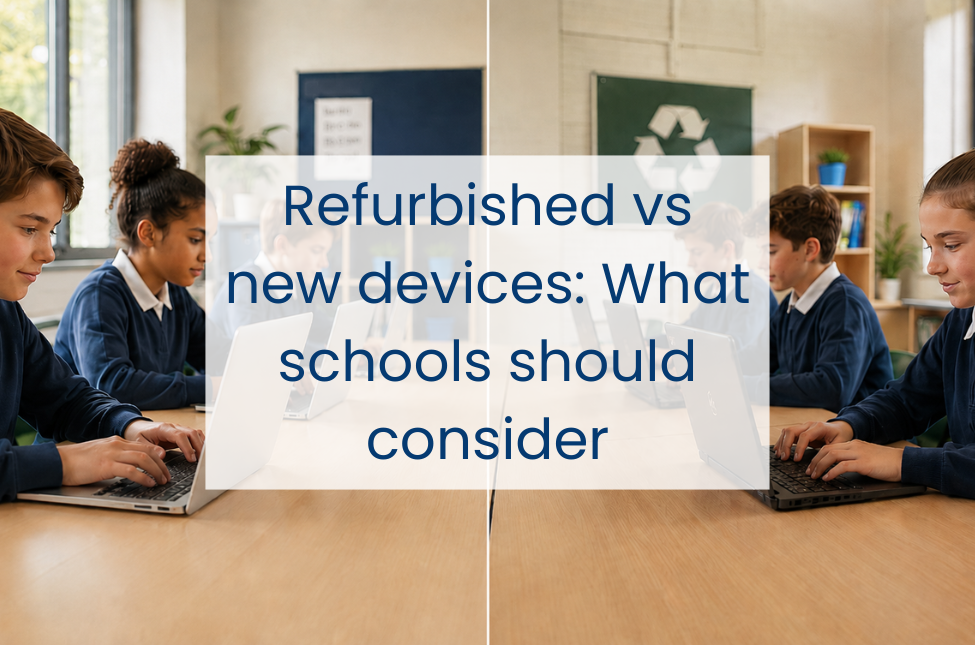
When device budgets are being reviewed, refurbished equipment often enters the conversation quite quickly. Sometimes that is driven by budget. Sometimes it is linked to sustainability goals. Often, it is both.
The important question is not simply whether refurbished devices are cheaper than new ones. Senior leaders need to know whether they are suitable for the role they will play, whether they can be supported properly, and how they fit into the wider device strategy over time.
As a fully compliant procurement service, Everything ICT supports schools in comparing suitable options, testing the market and buying through compliant routes, whether the requirement is for new devices, refurbished equipment or a blended approach.
What schools should expect from refurbished devices
“Refurbished” can cover a wide range of equipment, so the detail behind the label matters. A refurbished device should come with a clear grading standard, documented testing, secure data wiping, any necessary repairs, and a defined warranty and support position. Schools should also be clear on practical points such as battery health, the age and specification of the device, whether parts have been replaced, and how consistent the batch will be across a classroom or wider rollout.
Those details give schools a firmer basis for comparison. Without them, it becomes much harder to judge whether refurbished devices offer genuine value, how much usable life they are likely to have, and whether any apparent saving is likely to hold up once support, replacement and day-to-day use are taken into account.
Refurbished devices can be a credible part of a school ICT estate where provenance, condition, support arrangements and warranty are clear from the outset.
For a more detailed breakdown of what to check before buying refurbished equipment, read our Refurbished Device Guide for Schools.
The cost argument is real, but it is not the whole argument
The most obvious benefit of refurbished devices is cost. Where budgets are tight, the ability to buy more devices for the same spend, or replace older stock sooner, is attractive. In some cases, refurbished hardware can make a planned rollout possible where new devices alone would force a compromise on numbers or timing.
For senior leaders, though, the useful question is not “which is cheaper?” but “which gives us the best value over the period we need it?” A lower purchase price can be undermined if devices require more support, have a shorter usable life or create inconsistency across classrooms. Equally, buying new by default may mean paying for performance that some users simply do not need.
Everything ICT can support benchmarking, market engagement and route-to-market decisions so schools can compare whole-life value, not just the headline cost on a quote.
Sustainability is a valid reason, provided the devices still do the job
There is a strong sustainability case for extending the life of hardware where it remains fit for purpose. Reusing devices can help reduce e-waste and lower the environmental impact associated with manufacturing new equipment. The Department for Education has encouraged schools to consider sustainable IT hardware choices, and many schools are now expected to show how procurement decisions support wider environmental aims.
But sustainability should not be used to justify poor fit. A device that is technically reusable but too slow for the software pupils and staff rely on is not a good outcome. It risks frustration, reduced productivity and earlier replacement, which weakens both the financial and environmental case.
The strongest position is usually a practical one: use new devices where performance, longevity or compatibility are critical, and use refurbished devices where they can meet the need without compromise.
Reliability, warranty and performance need proper scrutiny
This is where many school leaders become understandably cautious. A device strategy only works if staff trust the kit and lessons are not repeatedly interrupted by avoidable faults.
With new devices, warranty terms are usually familiar and performance expectations are easier to predict. With refurbished devices, schools should look carefully at:
- warranty length and what it actually covers
- battery health and replacement policy
- cosmetic grading versus functional grading
- age of processor and supported operating system
- availability of spare parts
- consistency across a batch
- imaging, setup and asset tagging arrangements
None of these points rule refurbished devices out. They simply need to be addressed explicitly. A cheaper device with a weak warranty may not be a bargain. A well-specified refurbished device with strong support may be entirely appropriate for a defined use case.
Everything ICT can help schools frame these requirements in procurement documents, compare supplier responses and avoid leaving important assumptions unstated. That support is particularly useful for schools without in-house procurement capacity or where ICT and finance teams need a common basis for decision-making.
The best answer may be a mixed estate
For many schools, the most sensible strategy is not refurbished versus new, but refurbished and new used deliberately.
A trust might choose new devices for staff laptops, specialist curriculum areas and devices expected to remain in service for the longest period. Refurbished devices may be well suited to general classroom access, loan stock, exam-season capacity or replacing older machines where the workload is modest and well understood.
This can also support a more mature lifecycle plan. Rather than allowing the estate to age unevenly until a large emergency refresh is unavoidable, schools can use different device types across different roles, with expected replacement points mapped in advance. DfE guidance recommends that schools take a strategic approach to digital technology, rather than treating individual purchases in isolation.
Everything ICT can support that wider planning by helping schools align purchases to need, budget cycles and procurement rules, while giving access to a broad supplier base and different award routes depending on the complexity of the requirement.
What good looks like
A good device decision is one a school can explain clearly to governors, trustees, staff and auditors. It should show that the school has considered educational need, affordability, sustainability, supportability and long-term value, rather than defaulting to the cheapest option or the newest option.
For some schools, that will mean buying new. For others, refurbished devices will be a sensible part of the answer. For many, it will be a planned combination of both.
With the right specification, supplier checks and procurement route, refurbished devices can play a useful role in a school’s ICT strategy. Everything ICT helps schools make those decisions with confidence, using a compliant framework that keeps the process practical, proportionate and focused on what the school actually needs.