
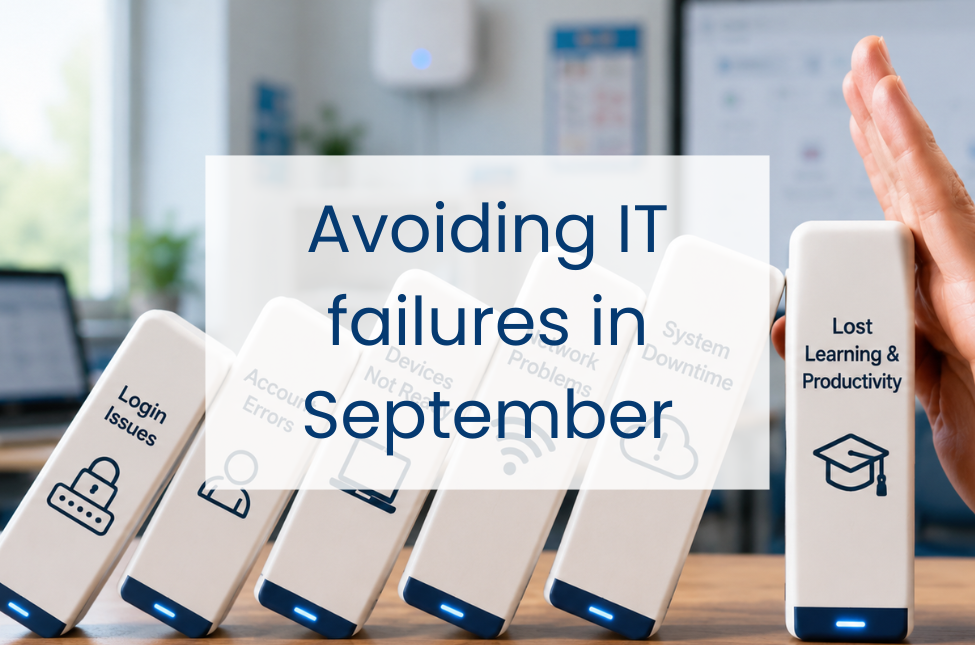
September has a habit of exposing every weakness in a school’s ICT setup at exactly the wrong time.
A system that seemed manageable at other points in the year can suddenly become a barrier to learning when hundreds or thousands of users return at once, new pupils need accounts, staff need access to systems, devices are being moved between rooms, and timetables have changed.
For senior leaders, the problem is not simply that ICT issues are inconvenient. It is how quickly they spill into the running of the school. If staff cannot log in, the network slows under pressure, devices are not ready or contracts have been allowed to drift, the consequences soon move beyond the IT office and onto SLT’s desk.
This is where early planning matters. Schools do not need to wait for problems to surface in the first week back before acting on them. With the right checks, supplier conversations and procurement routes in place before September, many of the most common issues can be reduced or avoided altogether. Everything ICT helps schools and trusts do exactly that, giving leaders access to compliant procurement support and trusted suppliers who understand the pressures of the education sector.
September pressure is predictable, even when the problems are not
ICT failures at the start of term are usually the result of several smaller gaps coming together at once.
Staffing changes, new pupil intakes, timetable updates and room moves all affect who needs access to what, and where. New staff, pupils and leavers each create different access requirements, from MIS and safeguarding systems to cloud platforms, filtering groups and allocated devices. If those changes are not handled cleanly before term starts, access issues can quickly start affecting teaching, administration and safeguarding.
For governors and trustees, the question is whether the school can show it has taken reasonable steps to prepare. For staff, that same question becomes practical very quickly: can they teach, communicate, safeguard and support pupils from the first day back?
Both questions matter, because September ICT readiness needs to provide assurance at leadership level and reliability at classroom level.
Login problems are rarely just login problems
Account access is one of the quickest ways for September ICT issues to show up. If new staff cannot get into the platforms they need, or pupils have been placed in the wrong groups, the problem is felt immediately in classrooms, offices and support teams. Password resets, single sign-on problems and mismatched user records across systems can quickly absorb IT time at the point when the school needs issues resolved, not queued.
On the surface, account access can look like a helpdesk issue. In practice, it affects teaching, safeguarding, communication and the pace of the school day. If access is not ready at the start of term, leaders are left managing avoidable disruption that could have been dealt with before staff and pupils returned.
The work needs to happen before term starts. New users should be created, permissions checked, leavers removed or archived, and password reset routes confirmed before staff and pupils are relying on them. Multi-factor authentication and single sign-on should also be tested across the tools people actually use, not just assumed to be working because the setup looks right on paper. For trusts, this is also a useful point to check whether identity management still reflects how the organisation works, particularly where shared services, central teams or cross-school roles have created more complex access needs.
Devices need more than a quick count
A school can appear to have enough devices on paper and still find itself short in practice. A full laptop trolley is only useful if the devices are charged, updated, reliable and where staff expect them to be. By September, the gap between “we have enough devices” and “we have enough usable devices” can quickly become clear.
For SLT, this is where a practical problem becomes a leadership one. Device readiness affects curriculum delivery, digital inclusion, staff workload and the credibility of any wider digital strategy. If the school has invested in devices, leaders need confidence that they are usable, secure and matched to how teaching and support actually happen across the school.
Summer gives schools the chance to build that confidence before the pressure returns. It is the right time to check which devices are working properly, which are nearing the end of their useful life, whether warranties and support arrangements are still in place, and whether devices are allocated where they are needed most. Classroom equipment and shared resources should be tested early enough for repair, replacement or reallocation decisions to be made properly rather than rushed in late August.
Where replacement, expansion or additional support is needed, Everything ICT gives schools and trusts a compliant route to approved suppliers for devices, peripherals, AV equipment and associated support services, helping leaders make decisions before device issues start affecting the school day.
Network capacity has become a teaching and learning issue
A slow or unreliable network does not just affect browsing speed. It can slow lessons, disrupt assessment, limit access to safeguarding systems and cloud platforms, and create friction in the basic running of the school day.
September often reveals capacity problems because demand changes quickly and all at once. Once staff and pupils return, the network has to support more connected devices, heavier use of cloud-based platforms, movement across the site and additional access needs from visitors, contractors or temporary staff. A setup that appeared stable before term can start to feel stretched as soon as normal school activity resumes.
Leaders do not need to be involved in the technical detail of every switch, access point or bandwidth decision. They do, however, need confidence that the network can support how the school actually operates. The key question is whether the network is ready for real school use, not just whether it appears stable before term starts. If there are weak points in coverage, performance, filtering or support arrangements, September is likely to expose them quickly.
Where there are doubts, it is better to address them before September than wait for staff and pupils to prove the point. Everything ICT can help schools and trusts access approved suppliers for network reviews, infrastructure upgrades, broadband and connectivity services, cybersecurity support and managed service provision. This gives leaders a practical route from “we know this is a risk” to “we have a plan in place.”
Summer planning is not an ICT luxury
The summer period is not quiet for schools, but it does provide a window to tackle work that is difficult to complete when pupils are on site. The start of term tends to run more smoothly when ICT readiness is built into wider planning, rather than treated as a separate technical task.
That means getting IT, operations, safeguarding, curriculum and senior leadership into the same conversation early enough to agree what needs to be ready, what has changed, and what could cause problems if left too late. A new timetable, staffing changes, different room use or a shift in device demand can all affect whether systems are ready for the first week back.
A practical readiness plan might include:
- Testing key systems using real staff and pupil scenarios
- Creating and checking new user accounts before staff return
- Auditing devices, classroom equipment and shared spaces
- Reviewing Wi-Fi coverage, filtering, monitoring and backups
- Checking supplier contracts, renewal dates and escalation routes
- Agreeing how ICT issues will be reported and prioritised
The point is not to remove every possible problem. No school can guarantee that. The point is to reduce avoidable disruption and make sure that when issues do arise, they are picked up early, prioritised properly and dealt with before they affect the wider school day.
What leaders need to know before September
Good ICT readiness is about making sure technology does not get in the way of teaching, safeguarding, communication or the basic running of the school day.
For senior leaders, the test is whether the essentials have been dealt with early enough and whether known weaknesses have a clear owner, plan and fallback. For MAT leaders, that visibility needs to hold across more than one setting, especially where systems, suppliers or support arrangements differ.
Everything ICT helps schools and trusts approach this in a structured way. Whether the need is device procurement, network improvement, cloud migration, cybersecurity review, specialist consultancy or a full managed service, we act as a procurement partner, helping leaders find the right support through a compliant and practical route.
September will always bring pressure. But there is a difference between normal start-of-term pressure and ICT disruption that could have been avoided. Schools are in a much stronger position when the basics have been checked, risks have been addressed and support routes are clear before staff and pupils return.