
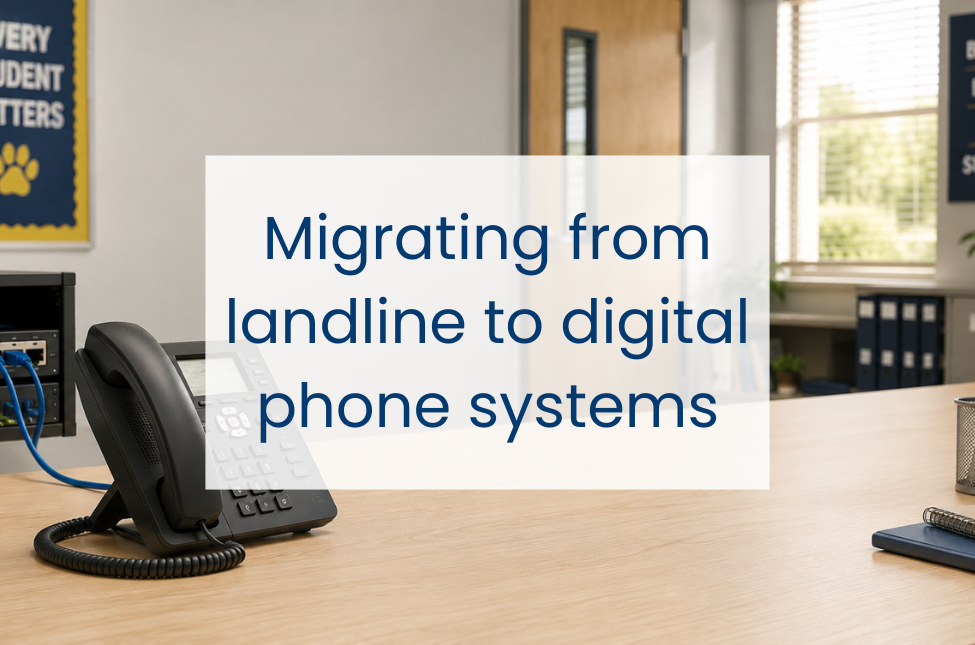
For many schools, telephony has been one of those systems that only gets attention when something stops working. It sits in the background, supporting reception, safeguarding, emergency contact and day-to-day operations.
The UK’s analogue phone network is being retired, with traditional landline services due to be switched off by the end of January 2027. Calls are moving to digital services that run over internet connections rather than the old copper phone network.
For schools and MATs, the migration affects operational resilience as much as telecoms. Phone systems connect into safeguarding, attendance, emergency response, site management and business continuity. If the move is treated as a like-for-like technical swap, important dependencies can be missed.
This is wider than the main phone system
The obvious starting point is the main phone system: reception, office handsets, voicemail and call routing.
The harder part is finding the lines that sit outside that system. In many schools, analogue lines still support services managed by estates, alarm providers or other suppliers. Lift phones, alarm signalling, door entry and gate controls are common examples, but the exact list will vary by site.
That is where schools can run into problems. The core phone setup may be ready to move, while a critical service in the building still depends on an analogue line nobody has mapped.
Before any migration, schools should have a clear view of what lines exist, what each one supports, which supplier owns it and what needs replacing, removing or redesigning. Everything ICT’s Landline Switch-Off for Schools guidance can help teams work through those less obvious dependencies, particularly where phone lines are spread across estates, ICT and external suppliers.
Digital phones change the resilience question
Traditional landlines carried their own power from the exchange. Digital services usually depend on local power, broadband connectivity and network equipment on-site, so resilience needs to be designed into the migration from the start.
Schools and MATs should understand how critical systems are affected during a power cut, broadband outage or network failure. Reception, emergency calls, safeguarding, attendance and site teams may all depend on the phone system being available, so fallback arrangements need to be agreed before migration. That includes mobile coverage, alternative contact routes and UPS protection for the network equipment the service depends on.
Set the requirements before comparing systems
It is easy for digital telephony projects to become a comparison of handsets, licences and call packages. Those things matter, but they should come after the school has set out what the service needs to do.
For a single school, requirements usually start with how the phones are used day to day: reception, office teams, site staff, emergency contact and any staff who need access away from the desk.
For a MAT, the question often becomes how consistent the model should be across sites. Central management, reporting, support, contracts and onboarding all need considering if the trust wants a service that can scale cleanly.
The right answer will not be the same for every school or trust. A small primary, a large secondary and a growing MAT will each have different call patterns, staffing models, estate risks and support arrangements.
Everything ICT can support schools and MATs by helping them access suitable telecoms and infrastructure suppliers through a fully supported, compliant procurement service. That can reduce the burden on internal teams while still keeping the decision grounded in the school’s actual requirements.
Supplier ownership needs to be clear
Telephony often overlaps with broadband, networks, estates systems and third-party support. During migration, ownership needs to be clear.
Call quality issues, alarm line conversions and connectivity failures can all involve more than one supplier or area of responsibility. The migration plan should make clear who owns each part of the service, who restores it if something fails, and what fallback is in place.
A strong migration plan should show which suppliers are involved, what each one is responsible for, what dependencies exist and how the system will be tested before handover. For MATs, it should also show how lessons from one site will be carried into the next.
Testing should reflect school life
A phone system can pass a technical test and still frustrate users on the first busy morning.
Testing should reflect how the school actually uses the phones. Reception flows, absence reporting, safeguarding calls, voicemail, transfers and out-of-hours messages should all be checked in context, along with any line-dependent services used across the site.
This is also the point to confirm what staff need to know. A new system does not need a long training programme, but reception, office teams, site staff and senior leaders should understand the features they will actually use. They should also know what to do if the system is unavailable.
Migration is a chance to tidy the model
The digital phone migration gives schools a chance to tidy arrangements that may have built up over time. Old lines, unused handsets, outdated call routing, legacy numbers and supplier arrangements can all remain in place long after the original reason has gone.
A planned migration is a good moment to decide what still supports the way the school works, what can be simplified, and what should be removed from the service altogether. That might mean rationalising lines, standardising support, improving resilience, updating call flows or bringing several sites under a clearer trust-wide approach.
Get clear before the switch-off
By the time analogue services are withdrawn, schools should have a clear view of what still uses the old network. Lines should be mapped, dependencies understood, resilience considered, supplier responsibilities agreed, and the new system tested against the way the school actually works.
Schools and MATs can use Everything ICT’s landline switch-off resource as a starting point for reviewing current lines, identifying dependencies and planning the move to digital services before January 2027. Where the requirement is already clear, Everything ICT can help schools access suitable suppliers and start the procurement process through a fully supported, compliant service.