AI is already finding its way into classrooms, staff workflows and student use—often faster than schools can formally respond. From drafting content to supporting lesson planning, tools are being used in different ways across the school, sometimes without clear oversight.
That is why more schools are starting to formalise their approach. An AI policy is not about restricting use—it is about setting expectations, reducing risk and giving staff and students a shared understanding of what responsible use looks like.
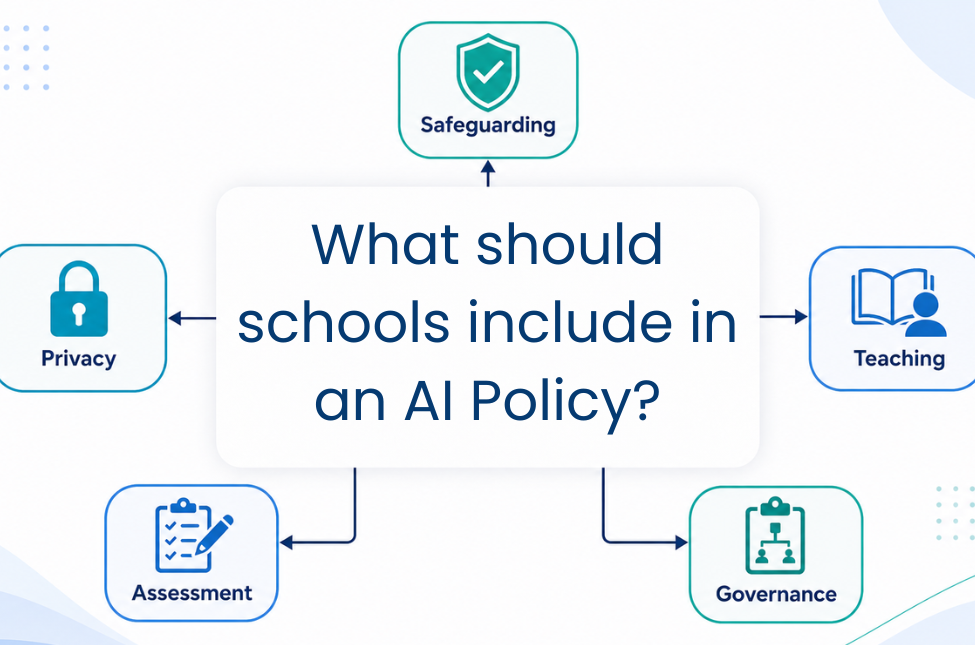
To support schools with this, Everything ICT has developed AI policy considerations for schools and MATs, designed to help leaders think through the key areas a policy should cover, from acceptable use and data protection to safeguarding, staff guidance and governance.
Why schools need an AI policy
For school leaders, the issue is not whether AI exists in education. It already does. The question is how it should be used in a way that supports teaching, protects pupils and fits with the school’s wider responsibilities.
Without agreed guidance, staff may take very different approaches. One department might use AI confidently, another might avoid it completely, while students may be unclear about what counts as acceptable support and what crosses the line into misconduct.
A policy gives the school a consistent position. It also helps connect AI use to existing responsibilities around safeguarding, data protection, curriculum, assessment and professional standards.
Acceptable use
Most schools begin their AI policy by defining acceptable use in plain language.
For staff, this means being clear about where AI can support work, such as drafting ideas, adapting resources or helping with administrative tasks. It should also set clear boundaries around what must not be entered into AI tools, including pupil information, staff details, safeguarding notes, assessment data or any other personal or confidential information.
The policy should explain where caution is needed. AI outputs should not be treated as automatically accurate, unbiased or suitable for pupils without professional review.
For students, acceptable use needs to link closely to academic integrity. Schools should be clear about when AI support is allowed, when it must be acknowledged, and when it is not appropriate. This is particularly important for homework, coursework and assessed tasks.
Data protection and privacy
One of the clearest boundaries should be around the information staff and pupils can put into AI tools. Personal data, safeguarding information, assessment records, behaviour notes and confidential staff information should not be entered into public AI tools.
The policy should link back to the school’s existing data protection guidance, so staff are not trying to follow two separate sets of rules. It should make clear what must not be shared, whether any approved tools should be used, and who staff can ask if they are unsure.
Safeguarding considerations
AI tools can produce responses that are inaccurate, inappropriate or biased. Pupils may also use them in ways that create risk, such as generating harmful content, relying on outputs without checking them, or sharing information that should be kept private.
The policy should explain how AI use will be managed, how concerns should be reported, and how existing safeguarding processes apply. It should also recognise the role of digital literacy, helping pupils question AI-generated content rather than assuming it is accurate, appropriate or safe.
Safeguarding leads, pastoral teams and curriculum leaders should all be involved in shaping this part of the policy.
Guidance for staff
Staff are more likely to apply the policy confidently when it includes practical examples, not just restrictions. The policy should help them understand where AI might be useful, where caution is needed, and when professional judgement must come first.
This is particularly important where AI is used to create or adapt materials for pupils. Staff should review anything AI produces before it is shared, and the school may want to set expectations around transparency and accountability.
Training will help bring the policy to life. Staff need time to discuss real examples, ask questions and understand what the school’s position means in day-to-day practice.
Leadership and governance
AI policy should not sit in isolation with ICT. The technical input matters, but the decisions also touch teaching and learning, safeguarding, assessment, workload, legal compliance and school culture.
Senior leaders should set the overall direction, involve the right people and make sure the policy aligns with existing documents. Governors may also need oversight, particularly where AI use creates risks around compliance, safeguarding or reputation.
The policy should be reviewed regularly, as both the tools and the ways people use them are changing quickly.
Practical tips for creating your first AI policy
For schools creating their first AI policy, it is best to start with the main risks and the most common use cases. Trying to cover every possible scenario can make the policy difficult to use.
A simple starting point could be agreeing:
- what staff can use AI for
- what students can use AI for
- what information must never be entered into AI tools
- how AI use should be acknowledged
- who is responsible for reviewing and updating the policy
From there, schools can build more detailed guidance over time. Everything ICT’s AI policy considerations can be used as a helpful reference when shaping your own approach.
Setting a clear direction
AI use in schools will continue to develop, but the principles behind good policy are already clear. Schools are likely to benefit from a consistent approach, clear boundaries, strong data protection, safeguarding awareness and confident staff guidance.
A good AI policy helps schools move away from uncertainty and towards responsible use. It gives leaders a framework for decision-making, staff the confidence to work within agreed expectations, and students clearer guidance on how AI can and cannot support their learning.