
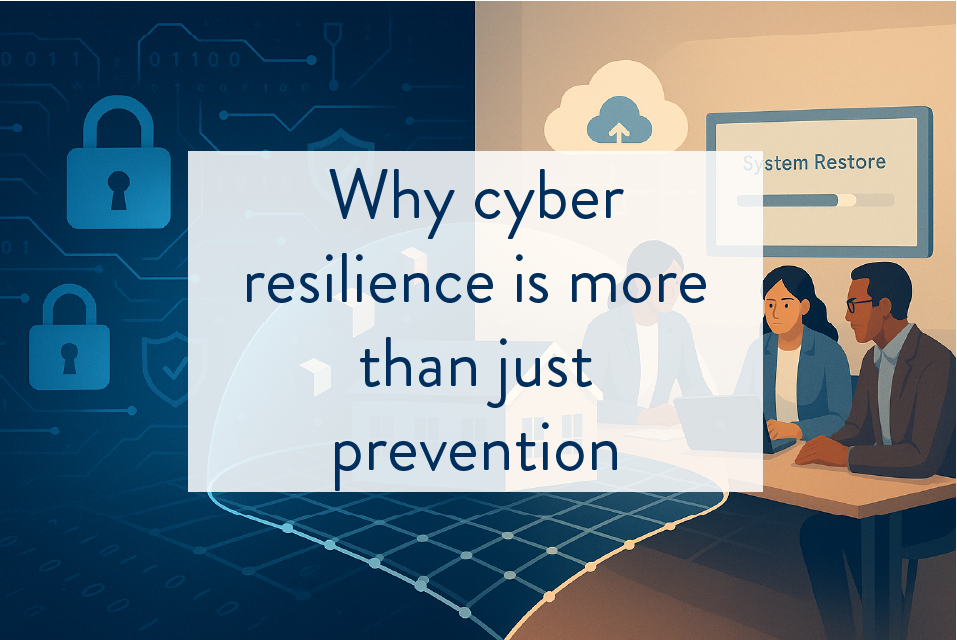
When it comes to cybersecurity, schools often focus on prevention — firewalls, training, policies — and rightly so. But prevention is only half the story. The other half is recovery: ensuring that when an attack does happen, your school can bounce back quickly with minimal disruption to teaching, safeguarding and student data.
Here, we discuss why recovery and cyber resilience deserve equal weight and how Everything ICT’s Department for Education (DfE)-approved framework can help schools build resilience through trusted suppliers and structured planning.
The recovery gap: when prevention fails
Think of cybersecurity like disaster planning for floods or storms. You can build strong defences, but you also need evacuation routes, backup supplies, and recovery plans for when things go wrong.
The DfE has warned that recovery times across the sector are getting longer. Some schools hit by ransomware have taken weeks to get systems back online, losing coursework, safeguarding data and access to critical services in the process.
Recently, the NCSC and The Guardian reported that over half of UK secondary schools experienced a cyber incident or data breach in the past year. Many had backups, but not all could restore them — either they were out of date, stored on the same network, or never tested.
A recent Ofqual report also noted that while the proportion of teachers receiving cyber training has increased from 61% to 72%, fewer schools are able to recover immediately from incidents (55% vs 63% in the prior year).
These figures point to a deeper issue: many schools lack tested resilience — robust backup systems, disaster recovery plans, and incident response playbooks. In other words, their posture is reactive rather than resilient.
Building resilience: the three pillars
True cyber resilience isn’t built overnight. It’s grounded in three core areas: secure backups, recovery planning, and a rehearsed response.
- Secure, tested backups
Backups should be stored separately from your main network — ideally offline or in immutable cloud storage. And they need to be tested regularly. A backup that can’t be restored isn’t really a backup.
- Disaster recovery planning
Schools should know which systems are most critical and in what order to restore them. Recovery plans should set clear timeframes (known as RTOs — Recovery Time Objectives — and RPOs — Recovery Point Objectives) so schools understand how quickly systems must be restored and how much data they can safely risk losing. - Incident response and communication
A well-practised response plan helps contain damage and maintain trust. Roles should be defined — who isolates systems, who speaks to parents, who reports to the DfE or ICO. Running regular “tabletop” exercises helps staff stay calm and confident under pressure.
Why prevention-only approaches fall short

It’s easy (and common) to over-invest in perimeter defences, endpoint protection, filtering, MFA, staff awareness programs — and neglect the recovery side. But that imbalance carries risks:
- A determined attacker often finds a way in. When they do, your recovery posture determines whether damage is contained or catastrophic.
- Attackers know that organisations that lack solid recovery will be more likely to pay ransoms. In other words, a weak resilience profile makes you a more attractive target.1
- Regulatory, audit, and reputational consequences escalate when a school cannot restore swiftly.
- Lost data — student coursework, staffing records, welfare logs — may never be recovered unless backups are sound and response well-managed.
So yes, prevention is necessary — but not sufficient. Resilience is your “insurance” when prevention is breached.
How Everything ICT’s framework supports resilient schools
As a DfE-approved framework, Everything ICT gives schools an easier way to strengthen cyber resilience. We bring together a trusted network of over 300 suppliers — from backup and disaster recovery specialists to cybersecurity consultants and managed service providers — all rigorously vetted for quality, compliance and value.
Through our framework, schools can:
- Access secure backup and disaster recovery solutions that meet DfE and NCSC standards.
- Procure services quickly and compliantly, without the long tender process.
- Work with expert partners to design and test incident response and recovery plans.
- Share best practice through guidance, templates, and case studies developed with sector specialists.
Everything ICT simplifies what can be a complex process — giving schools peace of mind that they’re protected both before and after an incident.
Final thoughts
Cyber resilience isn’t about assuming you’ll never be attacked — it’s about making sure an attack doesn’t bring your school to a standstill. Prevention keeps threats out; resilience gets you back on your feet.
With secure backups, tested recovery plans and a clear response framework — backed by Everything ICT’s approved supplier network — schools can turn a potential crisis into a short-term disruption.
Don’t wait for an incident to test your recovery plan.
Through our DfE-approved framework, schools can quickly access trusted partners for backup, recovery and response.
Get in touch today to find out how we can help strengthen your resilience strategy.
1. Note: As of mid-2025, the UK government is advancing proposals to make it illegal for public bodies to pay ransoms, and to require private organisations to report when they plan to do so. This change underscores just how important recovery and resilience are. (https://www.gov.uk/government/news/uk-to-lead-crackdown-on-cyber-criminals-with-ransomware-measures)