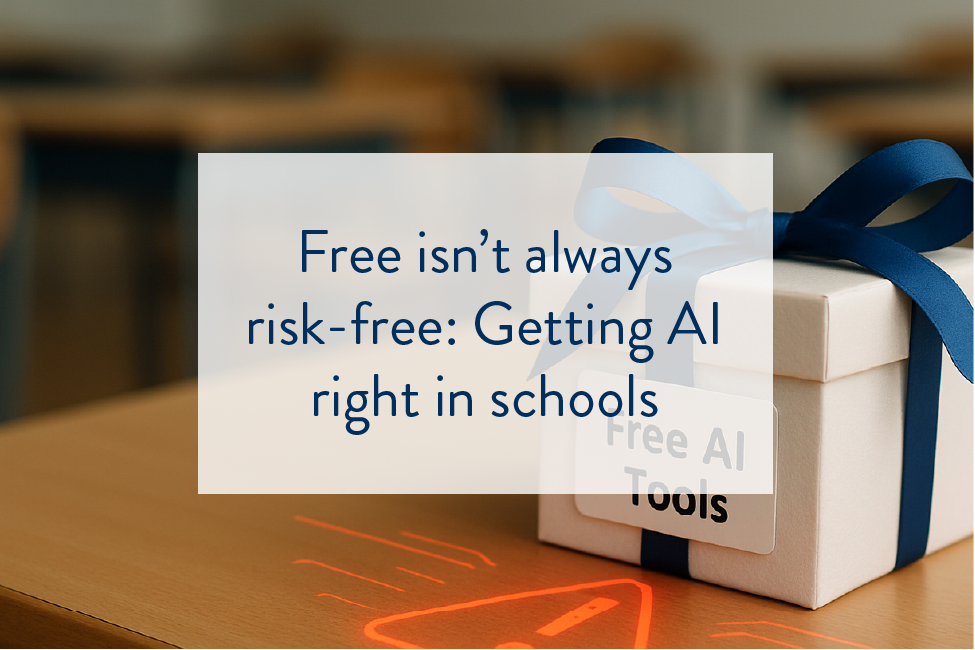
AI tools are quickly becoming part of daily life in schools. Teachers are using AI to draft letters to parents, generate lesson ideas, or for marking support— all at the click of a button. It’s easy to see why free AI tools are popular: they’re quick, accessible and, well, free.
However, as usage grows, so too does the need for clear guidance on how these tools are used — and how to protect sensitive data in the process. The question isn’t whether AI should be used in schools. It’s how it should be used safely, responsibly, and effectively.
The hidden risks of “free” AI tools
Many of the most widely used AI tools – whether chatbots, writing assistants, or image generators – store and process the information that’s typed or uploaded into them, often on servers located outside the UK. Every prompt, every file, every question might be retained and used to train future versions of that tool.
That becomes a problem when what’s being entered isn’t generic.
For example:
“Write a progress summary for Ethan Jones in Year 8 who struggles with maths but enjoys practical tasks.”
That single sentence could reveal personal information about a student. In a free, public AI platform, that data could leave the school’s control entirely.
For schools, that isn’t just a technical glitch — it’s a data protection and safeguarding issue. Under UK GDPR, any system handling student data must meet strict compliance standards, and most free AI tools simply don’t.
How to use free AI tools safely — and what the DfE recommends
That doesn’t mean schools have to avoid free tools entirely. Free AI tools can still be incredibly useful — but only when used thoughtfully and in line with the Department for Education’s (DfE) guidance on generative AI.
The DfE recognises that AI has real potential in education, but it also stresses that it must be used safely, responsibly, and with the right safeguards in place.
Here’s how schools can reduce risk — following both good practice and the DfE’s advice:
- Keep prompts anonymous. Never include names, addresses, or identifying details.
- Be cautious with what you share. Avoid entering any student or staff information into AI tools unless the platform has been properly vetted for compliance and security.
- Turn off chat history or model training in the tool’s settings (most major providers allow this).
- Avoid uploading documents that include student data or internal reports.
- Use school accounts rather than personal logins where possible.
- Use trusted suppliers for any task involving student data, analytics, or personalised learning — ideally through approved frameworks such as Everything ICT.
- Provide staff guidance on what’s safe to input and what isn’t.
Used this way, free AI tools are great for idea generation, writing templates, or CPD planning — anything that doesn’t rely on personal or confidential information.
📘 You can read the DfE’s full guidance on generative AI in education here.
When free isn’t enough
The DfE’s message is clear: free AI tools have their place, but when personal data or school systems are involved, they simply don’t offer the protection schools need. That’s when it’s time to look beyond free platforms and turn to education-grade AI solutions.
Through our DfE-approved framework, schools can find trusted AI suppliers who’ve already been vetted for security, compliance, and sector relevance.
Paid-for or licensed AI tools can offer:
- Secure data hosting within the UK or in GDPR-compliant jurisdictions
- Robust data protection agreements and clear ownership of any information shared
- Integration with school systems, such as MIS or learning platforms
- Detailed user controls and reporting, giving leadership visibility of how tools are being used
- Training and ongoing support, ensuring staff use AI confidently and effectively
These features don’t just make AI safer — they make it smarter for education. A compliant, supported tool allows schools to make the most of AI without the uncertainty or risk that often comes with free platforms.
Using AI the right way
Free AI tools can still be a great way to experiment and inspire new ideas — as long as they’re used carefully and anonymously. But when it comes to anything involving student data, staff information, or integration with school systems, education-grade AI from trusted suppliers is the only safe route.
By sourcing those suppliers through Everything ICT, schools get the assurance that every supplier has been properly vetted, DfE-compliant, and offers genuine value for money.
Because using AI in schools isn’t just about what the tool can do — it’s about making sure it does it the right way.
If your school or trust is exploring how to use AI safely and effectively, Everything ICT can help.
Our DfE-approved framework connects you with trusted, pre-vetted suppliers who understand the unique needs of education. From AI-driven classroom tools to data analytics and automation systems, we make it easy to find solutions that are compliant, cost-effective, and built for schools.